
Have you ever entered a room where the space looked good but felt subtly uncomfortable? This could be a sign of poor acoustics at work. Sound shapes how people move and feel in an environment – whether it is clear or not. Excess background noise, reverberation, echo and poor speech clarity can all create uncomfortable environments.
Noise Reduction Coefficient (NRC) is the simplest measuring tool to guide designers on how to improve that experience. By understanding how different NRC ratings affect sound absorption, spaces can shift from noisy chaos to sound havens.
In this guide, we will cover what the NRC rating actually means, what a good NRC rating is, and how to choose the right NRC rating for your project. You will learn exactly how to select an NRC rating that supports sound performance and design intentions, and what other factors need to be considered.
What NRC Actually Measures
NRC looks at how much sound a material can absorb instead of reflecting it back into a space. It is determined as a number between 0 and 1, with 0.00 meaning the material reflects almost all sound and 1.00 meaning it absorbs nearly all the sound energy that it is exposed to. In some cases, the NRC rating can go above 1.0.
When looking at materials specifically, and what that means from an NRC rating perspective:
Very low NRC materials, such as concrete, glass, and tiles, reflect sound and create echo. These must be used in conjunction with materials that absorb sound to balance noise.
Medium NRC materials, such as standard ceiling tiles or thin panels, can soften the sound in a space but are not effective enough on their own to completely balance a room's acoustics.
High NRC materials, such as purpose-designed acoustic panels, baffles and ceiling beams, significantly reduce reverberation and improve clarity. These materials are recommended for restaurants, offices or education environments where sound clarity is nonnegotiable.
Explore high-performance acoustic solutions from Baresque.


Why Some Acoustic Products Have NRC Ratings Over 1.0
Some products can have an NRC rating over 1.0. This doesn’t mean it absorbs more than 100% of the sound. Rather, it showcases how acoustic performance is captured in a laboratory environment.
NRC rating is tested in a reverberation chamber, where sound absorption is averaged across four key low to high frequencies from 200 Hz to 2000 Hz. As testing centres can capture sound absorption from multiple angles, three-dimensional forms and exposed edges can result in NRC ratings over 1.0.
For example, products such as Zintra Beams, Emerald Box Tiles and Hex Box Tiles sculptured forms can absorb more sound energy than a flat surface of the same size, resulting in test values like 1.2 or higher. In short, NRC over 1.0 showcases exceptional acoustic performance, but it is not always the full picture.
Check out our blog on Understanding NRC ratings and why some materials go beyond 1.0 to get a deeper understanding.
Why Higher NRC Isn’t Always Better
When choosing the right acoustic materials for a space, selecting the one with the highest NRC isn’t always the right choice. This is because acoustic performance is all about finding the right balance.
Over-absorbed rooms can feel:
Flat or lifeless
Uncomfortable for social interactions
At odds with the intended atmosphere
This is particularly true for collaborative spaces or restaurants where some natural liveliness boosts the environment and ambience. When it comes to acoustic solutions, the goal shouldn’t be silence but rather focus on clarity, comfort and control.
Choosing the right NRC depends on:
The function of the space
Occupancy and activity level
Ceiling height and surface finishes
The desired mood and ambience


Zintra Baffle Systems Quarter
How to Choose the Right NRC Rating — A Simple 5-Step Method
Step 1 — Identify Your Space’s Acoustic Problems
Start by conducting an audit of your space and identifying what isn’t working.
Common issues include:
Echo or “ringing” in hard-surfaced rooms
Poor speech clarity in meetings or classrooms
Noise spreading across open-plan areas
People raising their voices to be heard
As the NRC rating is all about improving sound within a room, it is important to distinguish between acoustic balancing and soundproofing. NRC is not about blocking noise but rather making the acoustics comfortable within a space.
Step 2 — Choose the NRC Range That Matches Your Space Type
The right NRC rating depends on the desired function, occupancy, ambience and aesthetics of a space. Each environment will require a different balance to achieve optimal absorption, clarity, and liveliness.
Open-Plan Offices
For open offices, reducing echo and reverberation can be a challenge. Selecting high NRC ceiling clouds or medium to high NRC wall panels can help manage lateral noise.
Meeting Rooms & Boardrooms
Using screens or wall panels paired with high NRC ceiling acoustic solutions can improve speech clarity. We recommend at least one treated wall in meeting rooms or boardrooms for optimal acoustic balance.
Classrooms and Learning Spaces
Wall-mounted pinboards and high NRC ceiling solutions help reduce reverberation and support speech clarity. These solutions add to the space without compromising on function.
Restaurants & Cafés
Using medium to high NRC acoustic materials helps control noise without killing the atmosphere. Ceiling rafts, clouds and wall panels or acoustic tiles keep spaces lively but balanced.
Lobbies & Receptions
In spaces with hard surfaces and high ceilings, using medium to high NRC materials helps create a sense of calm and reduce echo.
Studios, Theatres & Recording Spaces
For musical or performance environments, we recommend speaking with an acoustic specialist. This is because these spaces typically require a high NRC combined with balanced diffusion.
To achieve optimal results, acoustic performance must be carefully considered and finely tuned to achieve the right clarity, resonance and control across a wide range of frequencies.
Further Guidance on Acoustic Standards
For detailed guidance on acoustic performance based on the room type, we recommend referring to the WELL Building Standard (Features S04 and S05). These frameworks provide detailed recommendations for acoustic conditions across a range of environments.

Step 3 — Decide How Much of the Room You Need to Treat
While NRC tells you how absorbent a material is, coverage tells you how effective it will be. High-NRC panels perform best when specified in sufficient volume, where absorption, placement, and scale work together to balance a room. Combined, material performance and coverage help deliver a noticeable reduction in echo, even across larger spaces.
When determining how much coverage is needed, a guiding rule of thumb is:
Treat 25-50% of key wall and ceiling surfaces
Ceilings are often the most influential surface
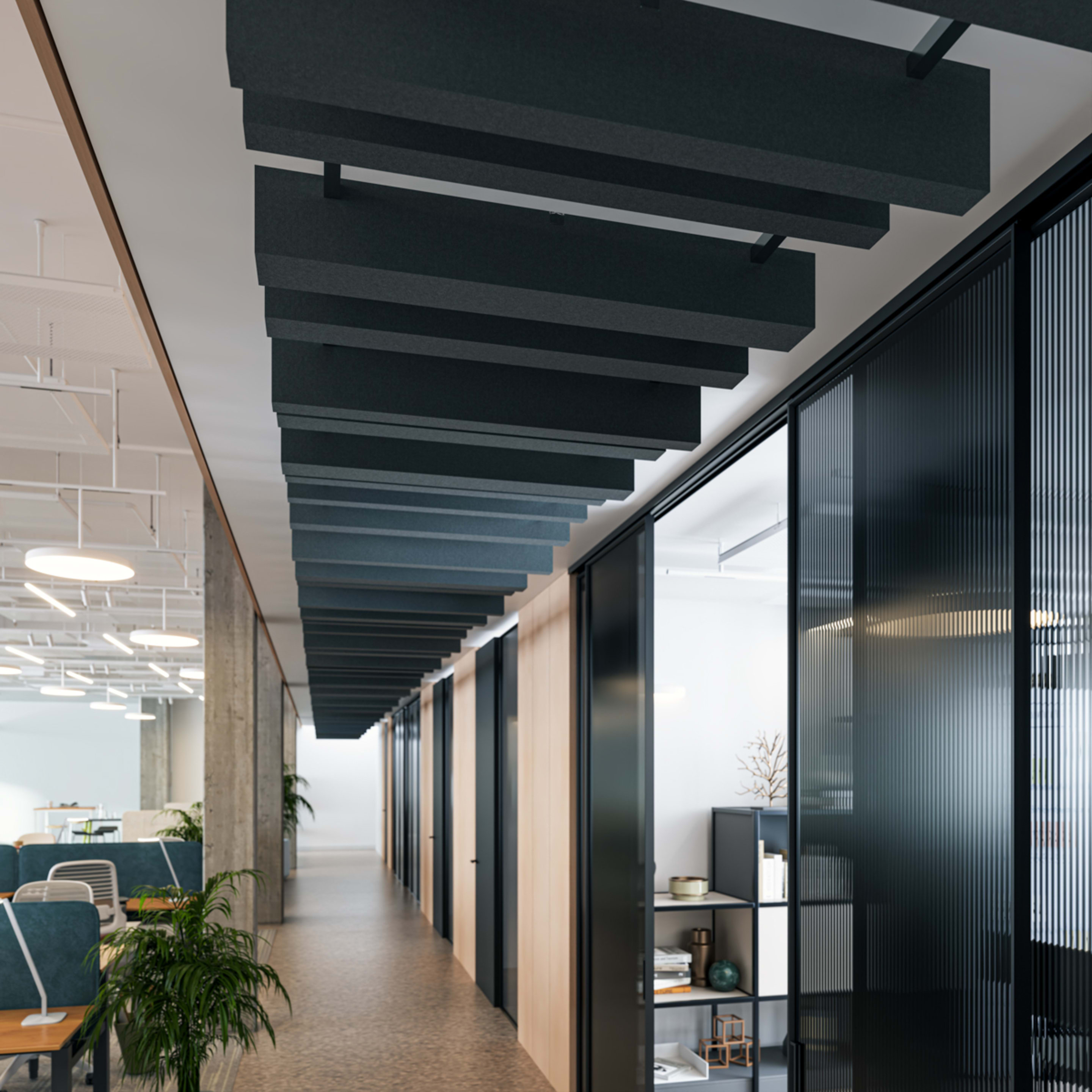
In high ceilings, rafts, acoustic baffles and clouds are particularly effective
Zintra’s Principle of 3 is a guiding framework for considering acoustic coverage and balance. The underlying principle is to distribute an absorber evenly across multiple planes within a space, particularly between parallel surfaces, to reduce reflection and create a balanced acoustic environment.
This typically involves treating a combination of walls and ceiling zones or placing an absorber between opposing surfaces to interrupt sound paths. Depending on the size and desired acoustics, this may extend beyond three planes. Rather than a fixed rule, this framework serves as a guiding principle which encourages layered and considered placement to achieve clarity, comfort and overall acoustic balance.
Step 4 — Understand the Factors That Affect NRC Performance
There are several considerations when it comes to how an NRC-rated material will perform. This is because the same material can perform differently depending on how it is used.
Key factors to consider are:
Thickness – thicker materials are better for low-frequency absorption.
Air gaps – creating space between the wall and the acoustic panel can increase performance.
Material type – soft or porous materials can absorb sound more effectively.
Mounting method – depending on the mounting type, when the material was tested, it can change the NRC results; this is an important consideration when selecting materials.
Ceiling installations – suspended acoustic solutions often create the biggest improvements as they intercept sound before it spreads across a room.


Step 5 — Choose the Right Baresque Product for Your NRC Target
At Baresque, we pride ourselves on our acoustic solutions. Here is the ultimate guide to selecting the right product for your NRC target.
High NRC Solutions
Zintra’s 12mm and 24mm panels, ceiling baffles, clouds and acoustic wall panels offer reliable and versatile solutions for offices, meeting rooms and educational environments. Their range of designs and organic forms seamlessly integrates into commercial interiors while delivering the best acoustic performance in the industry.
Explore our range of acoustic panels, acoustic baffles and acoustic ceiling clouds.
Ultra-High NRC Solutions (>1.0)
Zintra’s Beams, Hex Tiles and Box Tiles offer the highest NRC acoustic solutions with ratings all above 1.0. Designed to perform across a wide range of frequencies, their three-dimensional shapes absorb sound from multiple directions while delivering superior acoustic performance and a strong visual presence.
Integrated Performance Solutions — Enercee
Enercee 3D laminate acoustic panels, in solid colours and wood grain designs, combine acoustics and high performance to deliver outstanding performance and design for commercial environments. Ideal for spaces that demand both sound control and durability, Enercee panels help transform high-use interiors into calmer, more comfortable, and productive environments.
Design-Forward Screens & Feature Walls
At Baresque, we believe acoustic performance should not come at the cost of design. Decorative acoustic panels bring texture, patterns, rhythm and visual aesthetics without compromising on sound quality.
Explore our acoustic collection.
Real-World Examples
1. Open-Plan Workplace
Problem: Noise travelling across the room, causing staff distraction.
Solution: High-NRC ceiling elements paired with strategic wall panels.
Result: A calmer, more focused and private environment for speech clarity.
2. Café / Restaurant
Problem: Customers struggle to hear one another during busy periods.
Solution: Ceiling clouds or decorative wall panels help to absorb sound without taking away from the visual design.
Result: A lively but comfortable ambience, creating an inviting environment.
3. Classroom
Problem: Reverberation reduces speech clarity and causes increased fatigue.
Solution: High-NRC ceiling acoustic solutions or wall-mounted pinboards.
Result: Clearer communication and improved learning environments.

When to Consult an Acoustic Expert
In many cases, adding acoustic solutions will not need specialist advice. However, we recommend considering it if:
Spaces are unusually open or have very high ceilings
Speech privacy is critical, such as in open-plan offices
Performance requirements are high and require certain acoustics, such as in studios, theatres, and health environments
Get in touch with our team of experts for tailored NRC recommendations and product suggestions.
Final Takeaway
Choosing the right NRC rating is one of the most effective ways to improve acoustic comfort – directly shaping how a space is experienced. By aligning acoustic solutions with a room’s intended purpose and mood, interiors become calmer and more comfortable.
Baresque has over 50 years of experience in helping designers create spaces that look as good as they sound and feel. From subtle absorption in wall panels to high performing geometric shapes, our solutions are designed to bring sound balance and clarity to every space.
Ready to choose the right NRC rating? Explore Baresque’s acoustic solutions or contact our team for guidance.